


4
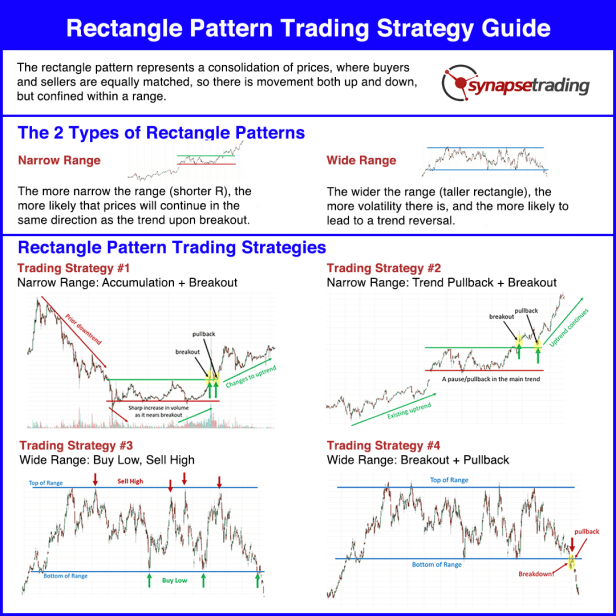
The Rectangle (Bullish) Pattern is one of the most reliable continuation patterns in technical analysis. It reflects a phase of healthy consolidation after a strong uptrend, where price pauses, builds energy, and then resumes its upward move.
In this detailed, plagiarism-free guide, you’ll learn how to identify, trade, and master the bullish rectangle pattern, with multiple trading strategies, examples, risk management tips, and SEO-optimized insights designed to perform well on Google Discover.
What Is the Bullish Rectangle Pattern?
A bullish rectangle forms when price moves sideways between two parallel horizontal lines after an uptrend:
- Upper boundary → Resistance
- Lower boundary → Support
This pattern signals indecision and accumulation, not weakness. Big players often use this phase to accumulate positions before the next leg up.
Key Characteristics
- Prior strong uptrend
- Flat, horizontal support and resistance
- Multiple touches on both levels
- Breakout happens above resistance
- Volume expands during breakout
Psychology Behind the Bullish Rectangle
Understanding market psychology gives you an edge:
- Early buyers take profits → price pauses
- New buyers enter near support
- Sellers fail to push price lower
- Supply dries up
- Breakout occurs when demand overwhelms resistance
👉 Sideways price ≠ weakness. It’s often preparation for expansion.
How to Identify a Valid Bullish Rectangle
✔ At least 2–3 touches on support and resistance
✔ No lower lows (support holds firmly)
✔ Pattern forms above key moving averages
✔ Volume decreases during consolidation
✔ Volume spikes on breakout
🚫 Avoid rectangles forming after downtrends — those are often bearish.
Bullish Rectangle vs Other Patterns
| Pattern | Bias | Structure |
|---|---|---|
| Bullish Rectangle | Continuation | Sideways channel |
| Bull Flag | Continuation | Slanted consolidation |
| Ascending Triangle | Bullish | Rising support |
| Bearish Rectangle | Bearish | Forms after downtrend |
Trading Strategies for Bullish Rectangle Pattern
Below are multiple proven strategies, suitable for intraday, swing, and positional traders.
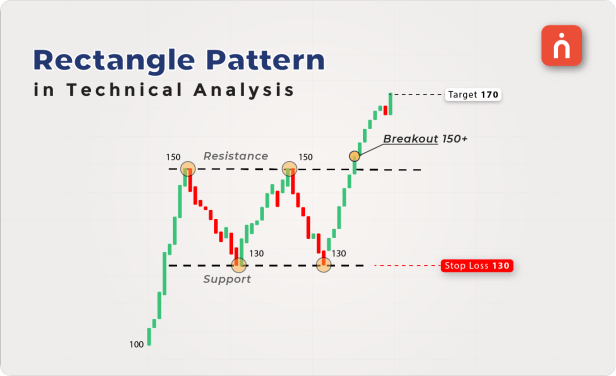
Strategy 1: Classic Breakout Trade (Most Popular)

Entry
- Buy above resistance
- Confirm with high volume
Stop Loss
- Below rectangle support
- Or below breakout candle low
Target
- Rectangle height projected upward
📌 Example:
If range = ₹20 → target = breakout price + ₹20
Strategy 2: Retest Entry (Low Risk)
Many breakouts retest resistance before continuing.
Entry
- Buy on pullback to previous resistance
- Look for bullish candle (Hammer / Engulfing)
Stop Loss
- Below retest low
Target
- Same as classic breakout target
✅ Higher accuracy
❌ May miss fast breakouts
Strategy 3: Range Trading Inside Rectangle (Advanced)
While waiting for breakout:
Buy Near Support
- Bullish reversal candle
- RSI above 40
Sell Near Resistance
- Partial profits only
- Not a short-selling strategy
⚠️ Best for experienced traders only
Strategy 4: Moving Average Confluence Strategy
Setup
- 20 EMA & 50 EMA rising
- Price holding above moving averages inside rectangle
Entry
- Breakout above resistance
- Price above EMAs
Stop Loss
- Below 50 EMA
🎯 Works exceptionally well in strong trending stocks
Strategy 5: Volume Expansion Strategy
Rules
- Volume contracts during consolidation
- Breakout candle volume = 2× average volume
Entry
- Buy on high-volume breakout
Exit
- Trail stop using VWAP or 20 EMA
📊 Ideal for momentum traders
Strategy 6: Rectangle + RSI Confirmation
Conditions
- RSI between 50–60 during consolidation
- RSI breaks above 60 with price breakout
Benefit
- Filters false breakouts
- Strong momentum confirmation
Strategy 7: Rectangle + Fibonacci Extension
Steps
- Draw Fibonacci from impulse move
- Rectangle forms between 38.2%–50%
- Breakout targets:
- 127.2%
- 161.8% extension
🎯 Excellent for positional trades
Strategy 8: Multiple Timeframe Confirmation
Example
- Daily chart → Bullish rectangle
- Hourly chart → Bull flag or mini rectangle
Entry
- Lower timeframe breakout
- In direction of higher timeframe trend
🔒 Improves win rate significantly
Stop Loss Placement Techniques
- Conservative → Below support
- Aggressive → Below breakout candle
- Dynamic → ATR-based stop
Never widen stop loss after entry.
Best Timeframes for Bullish Rectangle
| Trading Style | Timeframe |
|---|---|
| Intraday | 5m – 15m |
| Swing | Daily |
| Positional | Weekly |
Common Mistakes to Avoid
❌ Trading rectangle without prior uptrend
❌ Ignoring volume
❌ Entering before breakout
❌ Overleveraging during consolidation
❌ Confusing with distribution patterns
Bullish Rectangle Pattern in Indian Markets
This pattern works extremely well in:
- NIFTY stocks
- Banking & PSU stocks
- Midcap momentum stocks
- Breakout stocks near all-time highs
Liquidity improves reliability.
Frequently Asked Questions (FAQ)
Is bullish rectangle reliable?
Yes, especially when combined with volume and trend confirmation.
Can it fail?
All patterns fail. Risk management is mandatory.
Is it good for beginners?
Yes — it’s one of the simplest continuation patterns.
Final Thoughts
The Rectangle (Bullish) Pattern is a powerful yet underrated setup. When traded with discipline, volume confirmation, and proper risk management, it can deliver consistent profits across timeframes.
👉 Trade the breakout, respect the range, and let the trend do the heavy lifting.