

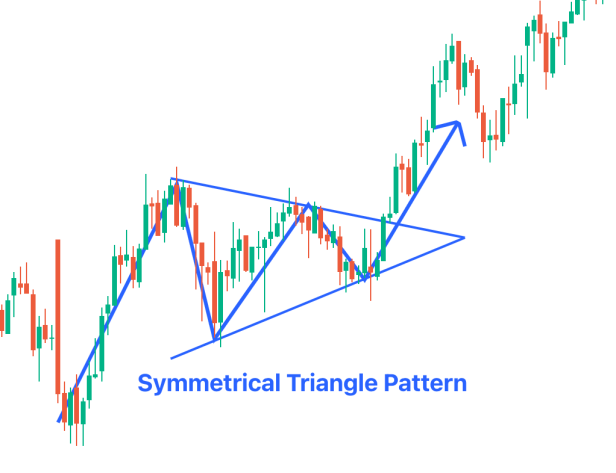
Symmetrical triangles are one of the most taught and most misunderstood chart patterns in technical analysis.
Almost every trader knows how to draw them. Very few know how to read them.
And that’s exactly why this pattern traps traders again and again.
👉 The one thing traders miss in symmetrical triangles is NOT the breakout direction — it’s the story inside the triangle.
Let’s break this down step by step.

What Is a Symmetrical Triangle? (Quick Recap)
A symmetrical triangle forms when:
- Lower highs create a descending trendline
- Higher lows create an ascending trendline
- Price compresses into a tightening range
- Volatility contracts before expansion
In theory:
- Breakout = trade
- Breakdown = short
- Target = height of the triangle
In reality?
That logic alone loses money.
The Fatal Assumption Most Traders Make
Most traders believe:
“Price is neutral inside a symmetrical triangle.”
That assumption is wrong.
Price may look balanced — but control is shifting silently.

The One Thing Traders Miss: Who Is Losing Control Inside the Triangle


A symmetrical triangle is not about price shape.
It’s about pressure transfer.
Inside every symmetrical triangle:
- One side is gradually losing urgency
- The other side is absorbing risk
- Liquidity is being positioned, not chased
Most traders never ask:
“Who is becoming weaker as price compresses?”
Why Breakouts Fail So Often in Symmetrical Triangles
The classic losing setup:
- Clean triangle
- Breakout candle looks strong
- Retail traders enter immediately
- Stops cluster below the structure
- Price snaps back violently
Why?
Because the triangle didn’t resolve pressure — it only stored it.
Volume: The Biggest Clue Traders Ignore
What traders expect:
- Volume contraction
- Sudden volume spike on breakout
What smart traders watch:
- Which swings are losing volume faster
- Which side fails to expand volume on attempts
- Whether volume expands before price breaks
👉 Volume should expand before the breakout, not after it.
If volume only spikes after the breakout candle:
- You’re late
- Smart money already acted
- You’re providing liquidity
The Real Meaning of Tight Price Action
When price compresses tightly:
- Stops become obvious
- Liquidity pools form
- False moves become more profitable than real ones
This is why symmetrical triangles:
- Produce fake breakouts
- Shake out both sides
- Then move cleanly after the trap
The One Question That Changes Everything
Before trading a symmetrical triangle, ask:
“If this breaks and instantly fails, who benefits?”
If the answer is:
- Market makers
- Institutions
- Smart money
Then that breakout is designed to fail.
How Smart Traders Actually Trade Symmetrical Triangles
1. They Stop Predicting Direction
Symmetrical triangles are not directional patterns.
They are:
- Volatility compression zones
- Liquidity-building structures
2. They Wait for the Reaction, Not the Break

Smart traders:
- Let the breakout happen
- Observe follow-through
- Enter on retests, not excitement
3. They Track Momentum, Not Just Price
If:
- RSI makes lower highs inside the triangle
- Momentum weakens near the apex
Then the first breakout often fails.
4. They Avoid the Apex
Breakouts near the very tip of the triangle are:
- Low energy
- High manipulation
- Poor risk-reward
The best moves happen:
- Before the apex
- Or after a fake-out
The Psychological Trap Behind Symmetrical Triangles
Symmetrical triangles:
- Look clean
- Feel safe
- Appear logical
That’s exactly why they work against most traders.
Markets don’t reward patterns.
They reward context, patience, and positioning.
Common Mistakes Traders Keep Repeating
❌ Entering immediately on breakout
❌ Ignoring volume behavior
❌ Trading the apex
❌ Assuming direction without context
❌ Treating triangles as signals instead of structures
The Real Lesson
A symmetrical triangle does not predict the future.
It exposes who is trapped.
Once you stop trading the lines and start reading the behavior inside them, your results change dramatically.
Final Thoughts: Trade What Happens, Not What “Should” Happen
Symmetrical triangles are powerful — but only for traders who understand market intent.
Next time you see one:
- Slow down
- Observe pressure
- Let the market reveal itself
Because the biggest moves usually come after most traders give up on the pattern.
Still struggling with inconsistent trading decisions?
The 48-Hour Trading Reset is a practical 213-page framework for controlling avoidable losses, rebuilding discipline, and creating a simple, repeatable trading process.
Educational use only. Trading involves risk and losses can occur.
Takeaway
Clean patterns attract crowds.
Crowds create liquidity.
Liquidity creates traps.
Trade accordingly.