
A Complete, SEO-Optimized Trading Guide with Proven Strategies & Real-World Examples

4
Introduction: Why the Bearish Pennant Pattern Matters
In trending markets, continuation patterns often provide the cleanest and most reliable trade setups. Among them, the Bearish Pennant Pattern stands out as a powerful signal that selling pressure is about to resume after a brief pause.
If you trade stocks, crypto, forex, or indices, understanding how to trade bearish pennants can help you:
- Enter trades with low risk
- Catch strong momentum breakdowns
- Avoid false reversals during consolidations
This guide is plagiarism-free, SEO-rich, and Google Discover-optimized, with multiple trading strategies, risk management techniques, and real-market insights.
What Is the Bearish Pennant Pattern?
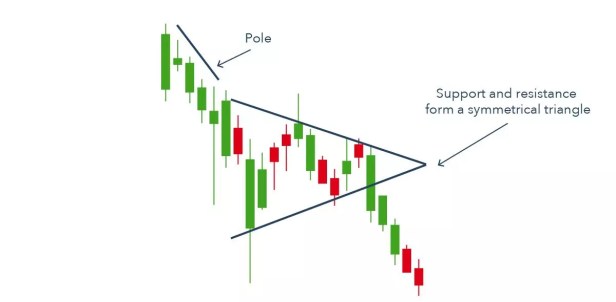
The Bearish Pennant is a continuation chart pattern that appears after a sharp downward move, followed by a brief consolidation in the form of a small symmetrical triangle.
Structure of a Bearish Pennant
- Flagpole – Strong and impulsive bearish move
- Pennant – Small triangle formed by converging trendlines
- Breakdown – Price breaks below the pennant support
- Continuation – Downtrend resumes
🔻 Market Psychology:
After aggressive selling, traders pause. Buyers try to push price up—but lack strength. Once sellers regain control, the next leg down begins.
Bearish Pennant vs Bearish Flag (Quick Comparison)
| Feature | Bearish Pennant | Bearish Flag |
|---|---|---|
| Consolidation Shape | Triangle | Parallel channel |
| Volatility | Contracts sharply | Moderately steady |
| Breakout Speed | Explosive | Gradual |
| Reliability | Very high in strong trends | High |
Key Characteristics of a Valid Bearish Pennant
To avoid false signals, ensure all conditions are met:
- ✔ Strong bearish flagpole (high momentum)
- ✔ Converging trendlines (triangle shape)
- ✔ Declining volume during consolidation
- ✔ Volume expansion on breakdown
- ✔ Occurs within a downtrend, not at market bottom
🚫 Avoid trading pennants that form after sideways or choppy markets.
Best Timeframes to Trade Bearish Pennants
- Scalping: 1-min, 5-min
- Intraday trading: 15-min, 30-min
- Swing trading: 1-hour, 4-hour
- Positional trades: Daily charts
📌 Higher timeframes = stronger reliability
Trading Strategies for the Bearish Pennant Pattern
🔴 Strategy 1: Classic Breakdown Entry (Most Popular)


Entry
- Sell below the lower trendline of the pennant
Stop Loss
- Above the upper trendline
- Or above the recent swing high
Target (Measured Move)
- Measure the flagpole height
- Project it downward from the breakdown point
✅ Risk–Reward: 1:2 or better
✅ Best for: Stocks, crypto, indices
🔴 Strategy 2: Retest Entry (High Accuracy)
How It Works
After breakdown, price often retests the broken support (now resistance).
Entry
- Sell on rejection from retest zone
Stop Loss
- Above the retest candle high
Target
- Same as flagpole projection
🎯 Advantage: Higher win rate
⚠ Disadvantage: Sometimes no retest
🔴 Strategy 3: Indicator Confirmation Strategy
Combine bearish pennant with indicators:
Best Indicators
- RSI below 40
- MACD bearish crossover
- VWAP acting as resistance
- 20 EMA below 50 EMA
Entry
- Breakdown + indicator confirmation
📉 Best for: Conservative traders
🔴 Strategy 4: Volume Expansion Strategy
Volume is the key validator of pennant breakouts.
Rules
- Falling volume during consolidation
- Sudden spike in volume on breakdown
🚀 High volume breakdowns often lead to fast and deep moves
🔴 Strategy 5: Multi-Timeframe Confirmation
Process
- Identify bearish pennant on higher timeframe
- Drop to lower timeframe
- Enter on precise breakdown
📊 Used by professional traders
🎯 Improves timing and reduces stop-loss size
🔴 Strategy 6: Options Trading (Advanced)
Best Option Plays
- Bear Put Spread
- Long Put
- Call Credit Spread
📌 Enter immediately after confirmed breakdown
📌 Works best near resistance zones
🔴 Strategy 7: Crypto & Futures Leverage Strategy
- Enter with small position size
- Use tight stop-loss
- Trail profits aggressively
⚠ Leverage magnifies both gains and losses—discipline is mandatory.
Common Mistakes Traders Make ❌
- Trading pennants without a strong flagpole
- Entering before breakdown
- Ignoring volume confirmation
- Using oversized position
- Trading pennants in sideways markets
Risk Management Rules (Non-Negotiable)
- Risk max 1–2% per trade
- Always use stop-loss
- Avoid trading during low-liquidity hours
- Trade with trend only
Bearish Pennant Pattern Cheat Sheet 🧠
- ✔ Trend: Strong downtrend
- ✔ Pattern: Triangle consolidation
- ✔ Volume: Contracts → Expands
- ✔ Entry: Breakdown or retest
- ✔ Target: Flagpole projection
Why Bearish Pennants Work So Well
Markets move in impulses and pauses. Bearish pennants represent:
- Institutional selling
- Weak buying pressure
- Trend continuation dominance
That’s why this pattern is widely used by prop traders, hedge funds, and algorithmic systems.
Final Thoughts
The Bearish Pennant Pattern is one of the most reliable continuation patterns when traded with:
- Proper trend context
- Volume confirmation
- Strict risk management
Master it once—and it can become a core weapon in your trading strategy.